The reason cancer feels impossible to cure is that it inherits our genome and couples it with the power of real-time evolution.
Real-time evolution shifts the natural selection process from iterating over entire generations to iterating over the life-cycle of a single cell.
This sped-up Darwinian selection means that when facing treatment weaker cancer cells die off while more resistant cells are selected to divide, thus creating a perpetual cycle of developing newer more expensive treatments for newer more evasive cancers.
What if we use real-time evolution to beat cancer at its own game and benefit the whole organism rather than weaponizing individual cancer cells?
An intelligent, holistic, real-time evolutionary feedback loop would not only be the end of cancer, but also the beginning of |
A real-time evolutionary feedback loop has three main components: information, intelligence, and delivery. Gathering granular real-time information is the most challenging component because at the subcellular scale the feasibility of in vivo photonic and ultrasonic data transmission is virtually nonexistent.
But if we use the information technology our bodies have already spent the past billion years developing, a massive wave of engineering possibilities opens up.
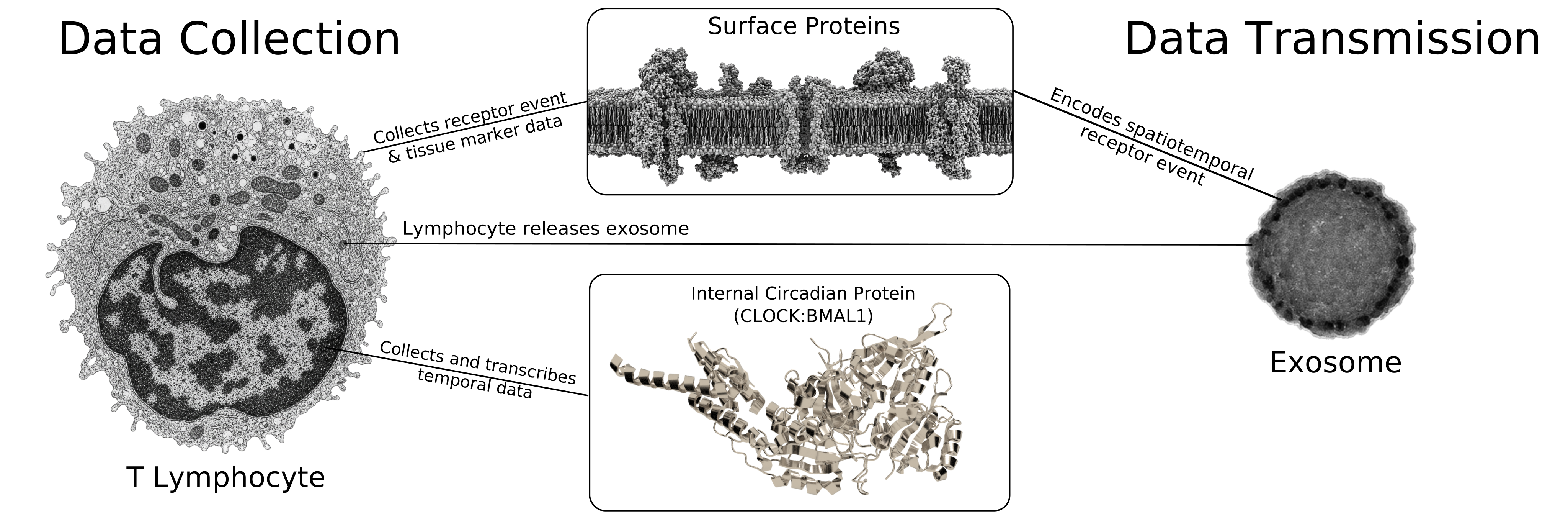
To gather information, custom white blood cells can circulate throughout the body carrying low-affinity rapid-dissociation receptors. These receptors will quickly and sparsely bind to key molecules and our body's natural "biological zip codes" while utilizing internal circadian clocks to provide temporal information. These receptor events can then trigger the transcription and release of exosomes that encode all of this information into discrete packets.
This way, thousands of cells can constantly release messages that encode "these molecules were found by this custom cell, in this location, at this time" which fundamentally solves the key informational requirements needed for a complete bioinformatic feedback loop. Our bodies already naturally release exosomes for cellular communication, but with this method we can control exactly what molecules need to be swept for and predictably decode these messages.
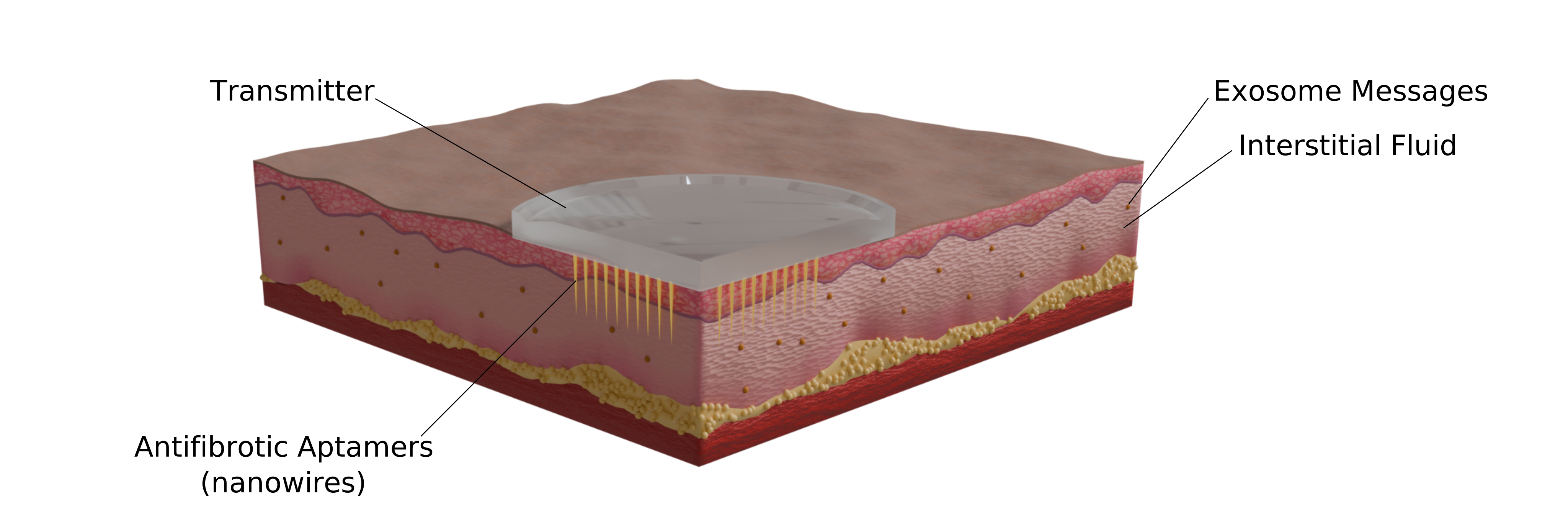
As these exosomes are released while containing spatiotemporal receptor events encoded on their surface proteins, anti-fibrotic interstitial nanowires can detect these messages, translate them into electromagnetic radio waves, and relay them to an ex vivo intelligence layer for analysis.
Nothing described above requires inventing novel materials/physics or waiting for a new type of "AI" to change everything. It can happen now. And this type of information would provide a constant, real-time molecular image.
Once these messages are made available to an ex vivo intelligence layer, mRNA payloads can be developed to tell the body exactly which proteins need to be made without permanently altering our genome or relying on custom drug synthesis for every individual.
Engineered white blood cells
The first physical component is an infusion of custom white blood cells. This serves as a single intravenous treatment that introduces the data-gathering cells directly into the patient's bloodstream. Once administered, these cells circulate continuously to map the body's molecular environment and package their findings into exosomes.
Interstitial sensor patch
This is a wearable hardware device applied directly to the patient's skin. It houses a minimally invasive array of nanowires that rest just below the epidermis. This patch continuously reads the biological signals generated by the custom white blood cells and wirelessly broadcasts that data to an intelligence layer.
Intelligence layer
This component is software that ingests the molecular snapshots transmitted by the sensor patch and processes the data to predict diseases and their corresponding mRNA therepeutic responses.
mRNA bioreactor
Closing the feedback loop is an automated point-of-care synthesizer. It receives the digital specifications from the intelligence layer and rapidly formulates a tailored mRNA payload.